Breast Reconstruction in Ahmedabad by Dr. Aniket Dave
Rebuilding the breast after cancer surgery — implant-based or with your own tissue, immediate or delayed — to restore wholeness, symmetry and confidence after mastectomy.
- Duration2 – 8 hours
- Recovery4 – 8 weeks by method
- AnaesthesiaGeneral
- Downtime6 – 8 weeks for flap reconstruction

The procedure, explained.
Breast reconstruction is the surgical rebuilding of a breast after it has been removed, partly or wholly, to treat cancer. A mastectomy saves a life, but it also takes away something deeply personal — and reconstruction is the part of cancer care that gives it back. It is not cosmetic indulgence; under Indian and international standards it is recognised as an integral part of breast cancer treatment, and for many women it is a right rather than a luxury. There are two broad routes. Implant-based reconstruction usually begins with a tissue expander placed under the chest skin and muscle, gradually filled over weeks to stretch the skin, then exchanged for a permanent implant. Autologous, or flap, reconstruction uses your own living tissue — most often the lower abdomen as a DIEP or TRAM flap, or the back as a latissimus dorsi flap — to build a breast that is warm, soft and ages naturally with you. Reconstruction can be immediate, performed in the same operation as the mastectomy, or delayed until cancer treatment is complete. The journey often ends with nipple-areola reconstruction and, where needed, surgery to the other breast so the two match. Dr. Aniket Dave plans every reconstruction alongside the breast and oncology team in Ahmedabad, because the right answer always begins with what your cancer treatment needs first, and what you want for the years that follow.
Is this procedure right for you?
Breast reconstruction is considered for women facing or recovering from mastectomy, and the right method depends on your cancer treatment, body and wishes.
- Planned mastectomy for breast cancer, suitable for immediate reconstruction
- Completed mastectomy seeking delayed reconstruction after treatment
- Risk-reducing (prophylactic) mastectomy for high genetic risk
- Partial defect after wide local excision needing oncoplastic repair
- Sufficient lower-abdominal or back tissue for an autologous flap
- Asymmetry after one-sided mastectomy wanting the other breast matched
- Wishing to avoid an external prosthesis and feel whole again
- Good enough general health to undergo reconstructive surgery
Reconstruction is a cancer decision first, and a personal one always.
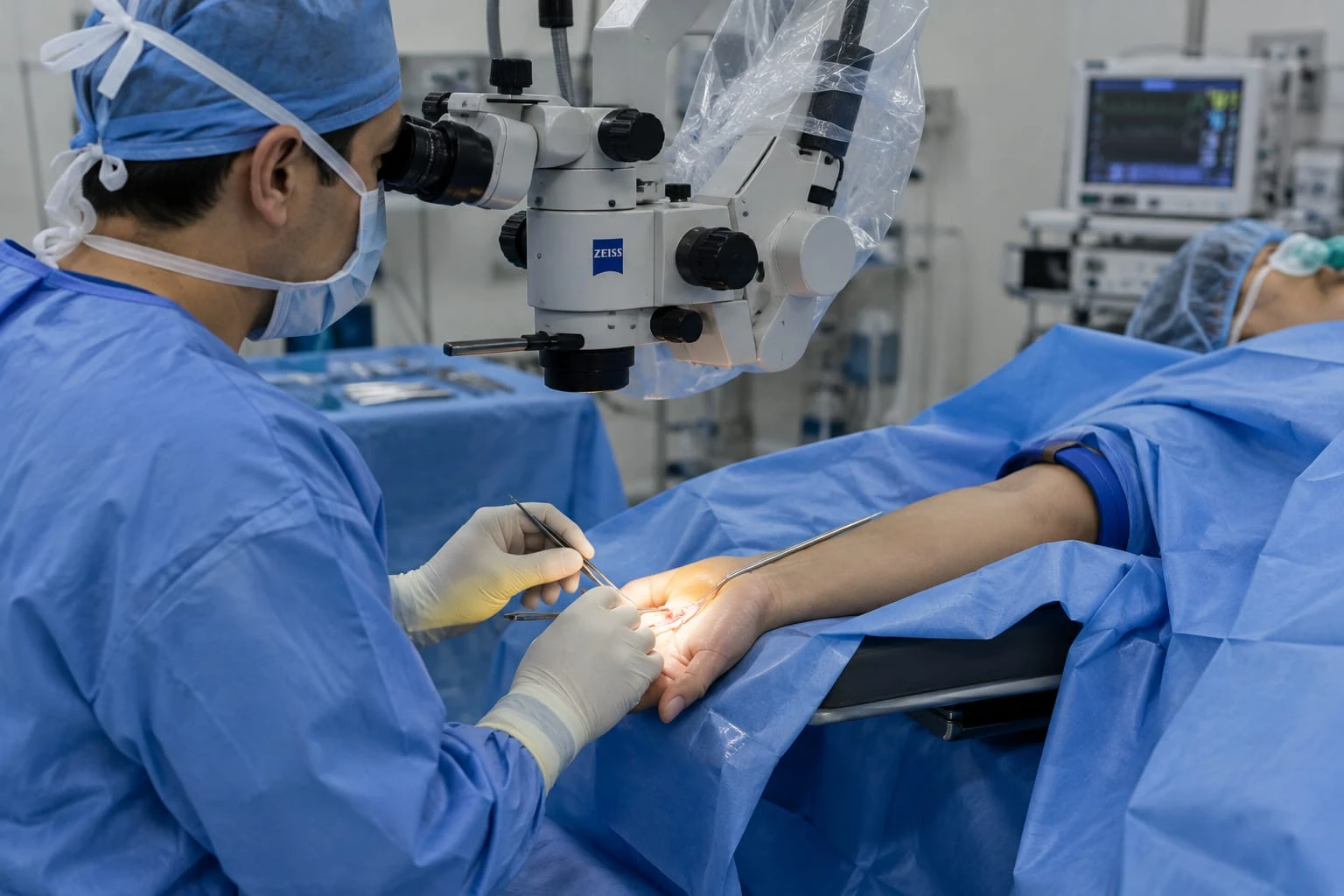
The right reconstruction begins with your oncology team, not the operating theatre. Dr. Dave coordinates closely with your breast surgeon and oncologist in Ahmedabad so that reconstruction never compromises cancer clearance, and so that planned radiotherapy or chemotherapy shapes the timing and method. Where radiotherapy is likely, autologous tissue often gives a more reliable long-term result than an implant. Where it is not, an implant-based pathway may be quicker and simpler. For immediate reconstruction, the plan is rehearsed jointly so the mastectomy and the rebuild flow as one operation. The method is chosen for you — your body shape, your tissue, your treatment and your priorities — never as a default. Surgery is performed under consultant anaesthesia, and flap reconstructions use the operating microscope to reconnect vessels under 2 mm. Above all, the conversation is unhurried and honest: every woman deserves to understand her options without pressure, in a private space, in language she can take home.
What happens on the day.
How a breast reconstruction is planned and carried out.
- 01
Joint planning with the cancer team
Method and timing are decided with your breast surgeon and oncologist, around your cancer treatment and radiotherapy plan.
- 02
General anaesthesia
Administered by a consultant anaesthetist for what may be a long operation; you sleep throughout.
- 03
Method 1 — expander or implant
A tissue expander is placed under skin and muscle, filled over weeks, then exchanged for a permanent implant; sometimes a direct implant is possible.
- 04
Method 2 — autologous flap
Tissue is raised from the lower abdomen (DIEP/TRAM) or back (latissimus dorsi) and transferred to rebuild the breast mound.
- 05
Microvascular anastomosis
For free flaps such as DIEP, the flap's artery and vein — often under 2 mm — are sutured to chest vessels under the operating microscope.
- 06
Shaping and symmetry
The new breast is contoured to match the other side; balancing surgery to the opposite breast may be planned now or later.
- 07
Nipple-areola reconstruction
Once the breast has settled, the nipple is rebuilt and the areola recreated, often finished with medical tattooing.
A realistic recovery, day by day.
Hospital care with drains in place. For flaps, intensive monitoring of the new blood supply. Pain is controlled and rest is encouraged.
Drains removed as output settles. Gentle movement begins; lifting and overhead reaching are restricted. Donor-site care for flap patients.
Most daily activities resume. Expander fills continue fortnightly where used. Swelling and firmness gradually ease.
Return to most normal activity and light exercise. Flap reconstruction patients regain strength and core stability over this period.
The breast softens and settles into its final shape. Nipple-areola reconstruction, tattooing and any symmetry refinements are completed.
Transparent pricing, no surprises.
As part of cancer treatment, breast reconstruction is often covered by medical insurance.
Breast reconstruction in Ahmedabad spans a wide range because the methods differ so much — a straightforward implant pathway is a different undertaking from a microsurgical DIEP flap that takes many hours in theatre. Implants, expanders, theatre time, hospital and high-dependency stay, and any surgery to balance the other breast all move the figure. Importantly, because reconstruction is recognised as part of breast cancer treatment, it is commonly covered by medical insurance — and we help patients and families navigate pre-authorisation and the paperwork so that cost never stands between a woman and feeling whole again.
- Method — implant/expander vs autologous flap (flaps cost more)
- Immediate (with mastectomy) vs delayed, staged reconstruction
- One breast or both
- Implants, expanders and any acellular dermal matrix
- Length of theatre time, microsurgery and hospital stay
- Surgery to balance the opposite breast and nipple reconstruction
Honest pre-op disclosure.
Reconstruction is well-established and safe in trained hands, but it is real surgery with real risks, which Dr. Dave will discuss with you honestly and without rushing.
- Implant-specific issues — capsular contracture, malposition, rupture or the need for future revision
- Flap-related risks — partial or, rarely, total flap loss requiring re-operation
- Donor-site problems after abdominal flaps — abdominal weakness, bulge or hernia
- Effects of radiotherapy on a reconstructed breast — firmness, shape change or implant complications
- Bleeding, infection, wound healing problems and changed skin or nipple sensation
- Asymmetry or contour irregularity that may need a refining procedure
6 specific commitments for breast reconstruction.
- Microsurgery is his core specialty — DIEP and free-flap reconstruction performed routinely, not occasionally
- Oncoplastic planning hand-in-hand with breast and oncology teams in Ahmedabad
- Comfortable across the full range — expander/implant, latissimus dorsi, TRAM and DIEP
- Structured hourly flap-monitoring protocol through the critical first 72 hours
- Unhurried, compassionate counselling that treats reconstruction as your right
- Care that follows through to nipple reconstruction and lasting symmetry
Questions patients ask about breast reconstruction.
You might also consider

A private conversation about what's possible.
Forty-five minutes with Dr. Dave. A clinical examination. 3D imaging where relevant. A written plan and transparent quote. No obligation, no upsell — just an honest discussion of your options.