Cleft Lip & Palate Surgery in Ahmedabad by Dr. Aniket Dave
Staged multidisciplinary care for babies and adults with cleft lip and palate — surgical correction supported by speech therapy, orthodontics and long-term follow-up.
- Duration1.5 – 4 hours per stage
- Recovery10 – 14 days per stage
- AnaesthesiaGeneral
- DowntimeSoft diet 2 – 3 weeks
The procedure, explained.
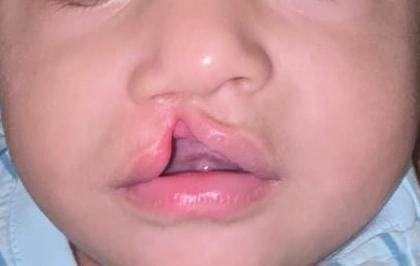
Cleft lip and palate is the most common craniofacial birth difference, affecting roughly 1 in 700 Indian births. Comprehensive cleft care is not one operation but a coordinated journey — primary lip repair around 3 – 4 months, palate repair around 9 – 18 months, alveolar bone grafting around 8 – 10 years, and secondary procedures (rhinoplasty, lip refinement, orthognathic surgery) into adolescence and adulthood. Speech therapy, audiology, orthodontics and paediatric dental care run alongside. Dr. Aniket Dave performs cleft surgery as part of a multidisciplinary care pathway in Ahmedabad. Through partnerships with cleft charities, we ensure financial barriers do not stop families from accessing the full care a child needs.
Is this procedure right for you?
Cleft care is for:
- Infants born with cleft lip, cleft palate, or both
- Children needing secondary cleft procedures
- Adolescents needing alveolar bone grafting
- Adults seeking secondary cleft rhinoplasty, lip revision or scar improvement
- Patients with submucous cleft palate causing speech issues
- Families seeking second opinions on staged cleft plans
A team. A plan. Lifetime follow-through.
Cleft surgery in isolation is not enough. Dr. Dave coordinates with paediatricians, anaesthesiologists, speech therapists, orthodontists, ENT specialists and dental surgeons to deliver care across the cleft timeline. For primary lip repair, the modern Fisher anatomical subunit approach gives the most natural lip and scar. For palate repair, the Sommerlad intravelar veloplasty preserves muscle anatomy critical for speech. For secondary cases (often adolescents and young adults), we plan combined cleft rhinoplasty, lip revision and where indicated orthognathic correction in a coordinated sequence.
What happens on the day.
Surgery is age- and stage-specific.
- 01
Cleft lip primary repair
At 3 – 4 months, weight ~5 kg, haemoglobin >10 g/dL. Fisher technique or Millard rotation-advancement.
- 02
Cleft palate primary repair
At 9 – 18 months. Sommerlad intravelar veloplasty with palatal lengthening.
- 03
Speech surgery (if needed)
Pharyngeal flap or sphincter pharyngoplasty for velopharyngeal insufficiency, around age 4 – 6.
- 04
Alveolar bone grafting
Age 8 – 10, iliac crest bone graft to alveolar cleft for canine eruption.
- 05
Secondary cleft rhinoplasty
After facial growth (16 – 18+); definitive cleft nose correction.
- 06
Orthognathic surgery
If significant maxillary hypoplasia — typically age 17+ after orthodontic preparation.
A realistic recovery, day by day.
Hospital stay 1 night. Sutures removed at day 7. Arm splints for 2 – 3 weeks to prevent suture trauma.
Hospital stay 2 – 3 nights. Soft diet for 3 weeks. No hard objects in mouth for 4 weeks.
Hospital stay 1 night. Soft diet 2 weeks. Donor site (hip) tender for 1 – 2 weeks.
Recovery similar to standard adult cleft rhinoplasty (~2 weeks).
Annual follow-up through skeletal maturity; speech therapy throughout.
Transparent pricing, no surprises.
Many primary repairs are free under NGO partnership programmes.
Cleft care affordability is non-negotiable for us. Primary lip and palate repairs for children of families with financial constraints are routinely supported through Smile Train / Operation Smile / Mission Smile NGO partnerships — at no cost to the family. We will help your family connect with the appropriate programme. For private cases, transparent stage-by-stage pricing is provided.
- Stage (primary lip, primary palate, secondary, etc.)
- Unilateral vs bilateral
- Insurance / NGO coverage
- Hospital stay per stage
- Pre-surgical orthopaedic devices (NAM) if used
Honest pre-op disclosure.
Cleft surgery is well-established and safe in experienced hands. Risk discussion is age- and stage-specific.
- Wound dehiscence at lip or palate (rare with careful technique)
- Velopharyngeal insufficiency after palate repair — may need secondary procedure
- Fistula after palate repair (5 – 10% in published series)
- Anaesthesia risk in infants — minimised with paediatric anaesthesia team
- Need for additional stages — this is expected, not a complication
- Speech outcome dependent on consistent therapy
5 specific commitments for cleft lip & palate surgery.
- Multidisciplinary team coordination — speech, orthodontics, ENT, dental
- Modern techniques (Fisher, Sommerlad) as standard
- NGO partnership access for cleft families in need
- Long-term follow-up across childhood
- Secondary adult cleft expertise (rhinoplasty, lip refinement)
Questions patients ask about cleft lip & palate surgery.
You might also consider
A private conversation about what's possible.
Forty-five minutes with Dr. Dave. A clinical examination. 3D imaging where relevant. A written plan and transparent quote. No obligation, no upsell — just an honest discussion of your options.