Breast Reconstruction After Mastectomy: Your Options Explained
A compassionate guide to reconstruction after breast cancer — timing, implant vs flap techniques, nipple reconstruction, recovery and insurance in India.

A mastectomy saves your life. What comes after — whether, when, and how to rebuild — is a separate decision, and it belongs entirely to you. There is no medically correct answer to that question. Some women choose reconstruction. Some choose to stay flat. Both are valid, and both can be the right choice for the woman making it.
This guide is written for women in Ahmedabad and across India who are facing or recovering from breast cancer surgery, and who want to understand their reconstruction options in plain language — without pressure, and without anyone rushing the most personal decision of all.
Reconstruction is a choice, and it is your right
First, the most important thing. Choosing to have your breast reconstructed is not vanity. Choosing not to is not giving up. This is your body, and the only person whose comfort matters is you.
A breast cancer diagnosis takes away a great deal of control. Reconstruction — including the decision to decline it — is one place where the control comes back to you. Take your time. You do not have to decide everything at once, and many options remain open even months or years after your mastectomy.
It also helps to know that reconstruction is a recognised part of cancer care, not an optional luxury bolted on afterwards. Wherever possible, your plastic surgeon and your cancer surgeon (oncosurgeon) should be talking to each other before your mastectomy, so that your options stay as wide as possible.
Timing: immediate or delayed
One of the earliest decisions is when reconstruction happens.
- Immediate reconstruction is performed during the same operation as the mastectomy. You go to sleep with a breast and wake up with the first stage of a new one. The advantages are fewer surgeries overall and the emotional relief of avoiding a flat-chest interval. It is best suited to women whose cancer treatment plan allows it.
- Delayed reconstruction is performed weeks, months, or even years later — once cancer treatment is complete and the body has healed. This is often the safer route if you will need radiotherapy, which can affect how reconstructed tissue heals.
There is no "better" answer. The right timing depends on your tumour, your treatment plan (chemotherapy, radiation), your general health, and your own readiness. A woman who needs radiotherapy may be advised to wait; a woman who does not may be a good candidate for immediate reconstruction. Your team will guide you, but the pace is yours to set.
Implant-based reconstruction
This is often the most familiar approach. It rebuilds the breast shape using a silicone or saline implant rather than your own tissue.
In most cases it happens in two stages:
- A tissue expander — a temporary, balloon-like device — is placed under the skin and chest muscle. Over several weeks, it is gradually filled with saline through a small port during quick clinic visits. This slowly stretches the skin to make room.
- Once the skin has expanded enough, a second, shorter operation swaps the expander for the permanent implant.
In selected patients with enough healthy skin, a one-stage ("direct-to-implant") reconstruction is possible.
Why women choose it: the surgery is shorter, there are no additional scars elsewhere on the body, and recovery from each stage is generally quicker than flap surgery.
Things to weigh: implants are devices, and they may need replacement or revision over a lifetime. They can feel firmer than natural tissue, and results after radiotherapy are less predictable. A reconstructed breast also does not change with weight or age the way the other one does.
Autologous (flap) reconstruction
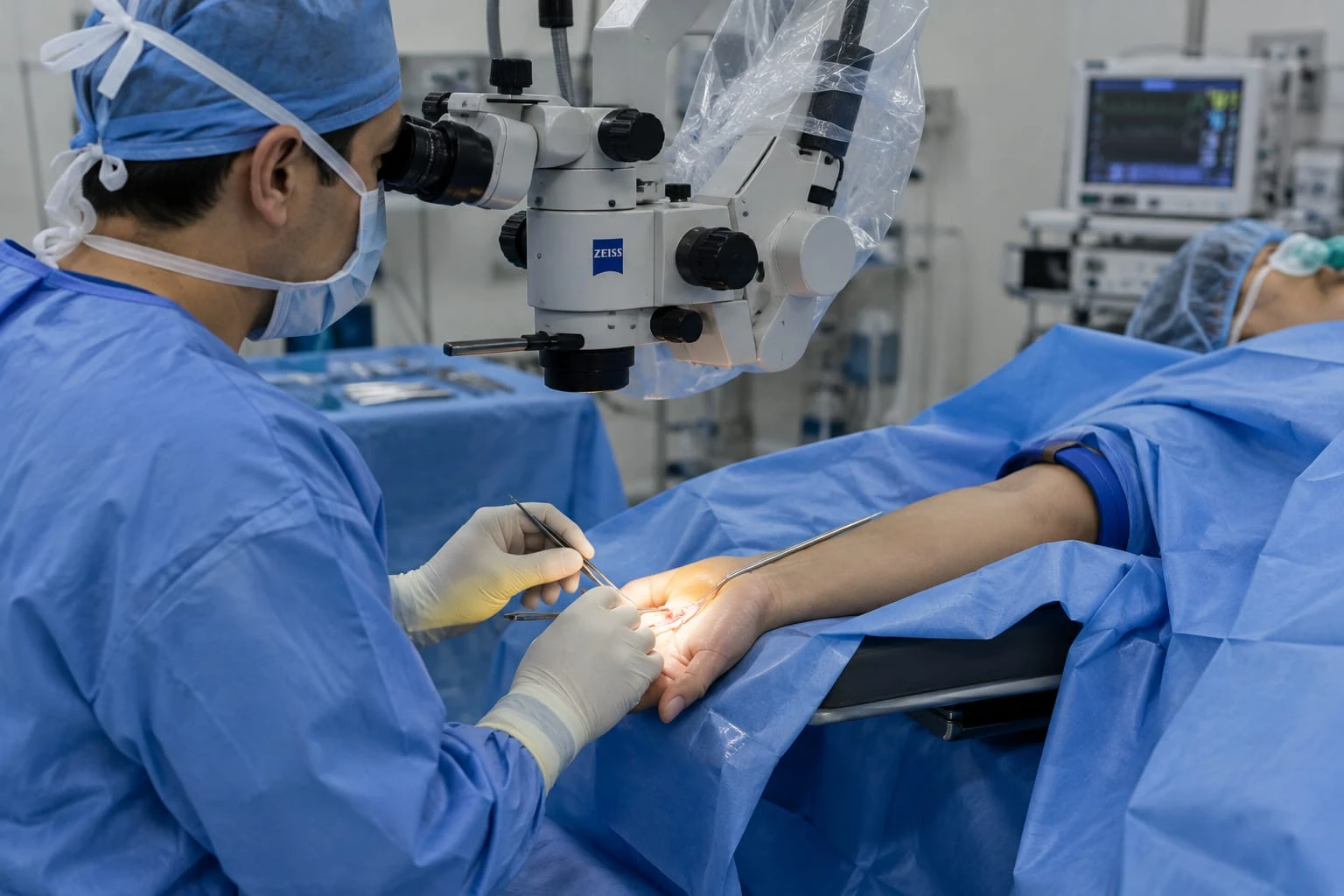
Flap reconstruction rebuilds the breast using your own tissue — skin, fat, and sometimes muscle — taken from another part of the body. Because it uses living tissue, the result often looks and feels the most natural and ages with you. This is the area where microsurgical training matters most, as the finest techniques involve reconnecting tiny blood vessels under a microscope.
The common types are:
- DIEP flap — tissue is taken from the lower abdomen (similar to the area removed in a tummy tuck), but the abdominal muscle is preserved. The blood vessels are reconnected to the chest using microsurgery. It gives a natural result and spares muscle strength, but it is a longer, technically demanding operation with a recovery for both the breast and the donor site.
- TRAM flap — also uses lower-abdominal tissue, but takes some abdominal muscle along with it. It is effective and widely performed, though it can leave the tummy wall weaker than a DIEP.
- Latissimus dorsi flap — uses muscle and skin from the upper back, tunnelled around to the chest. It is reliable and well suited to women who do not have enough abdominal tissue, and is sometimes combined with a small implant for added volume. The trade-off is a scar on the back and some change in shoulder strength.
Flap surgery is a bigger undertaking than implant surgery, with a longer hospital stay and recovery. In return, many women value a breast made entirely of their own tissue.
Implant vs flap reconstruction at a glance
| Consideration | Implant-based | Flap (autologous) |
|---|---|---|
| Source of volume | Silicone or saline device | Your own tissue |
| Surgery length | Shorter | Longer |
| Hospital stay | Shorter | Longer |
| Recovery | Quicker, staged | Longer, single donor site to heal |
| Look and feel | Good; can feel firmer | Often most natural; ages with you |
| Extra scars | None beyond the chest | Yes (abdomen or back) |
| After radiotherapy | Less predictable | Generally tolerates it better |
| Long-term maintenance | May need replacement over time | Usually a one-time reconstruction |
This table is a starting point for conversation, not a scorecard. The best option is the one that fits your anatomy, your treatment plan, and your priorities.
Finishing touches: nipple and areola
For many women, rebuilding the breast mound is only part of feeling whole again. The nipple and areola can be recreated in a later, minor procedure — usually once the breast shape has settled.
- A nipple can be reconstructed by folding small flaps of local skin to create a natural projection.
- The areola is then recreated using medical tattooing (micropigmentation), which adds realistic colour and, with skilled artistry, a remarkably lifelike three-dimensional appearance.
Some women choose tattooing alone; some choose the full nipple reconstruction; some choose neither. Each of these is completely reasonable.
Balancing the other breast
If only one breast was removed, you may want the reconstructed side to match your natural one as closely as possible. Procedures on the other, healthy breast — a lift, a reduction, or a small augmentation — can improve symmetry so that you feel balanced in clothing and out of it. This is a normal, expected part of reconstruction planning, and it is worth discussing openly with your surgeon.
What recovery really looks like
Honesty helps more than reassurance here. Recovery takes time and patience.
- Expect drains for a week or two after surgery, soreness, and tiredness as your body heals.
- Implant recovery is generally faster; the expander-filling phase is spread over several weeks of short visits.
- Flap recovery is longer because two areas — the breast and the donor site — are healing at once. Lifting and strenuous activity are restricted for several weeks.
- Sensation in the reconstructed breast is usually reduced and may not fully return. This is one of the realities to know in advance, not after.
- Final results take months to settle as swelling fades and scars mature.
Go gently with yourself. Your body has already been through cancer treatment; reconstruction is one more thing it is recovering from, and rest is part of the work.
Cost and insurance in India
There is good news here. Under the Insurance Regulatory and Development Authority of India (IRDAI) norms, reconstructive surgery that follows cancer treatment is considered medically necessary — not cosmetic — and is therefore covered by most health insurance policies, including many government schemes. Because it restores what disease and surgery took away, it should not be treated like elective aesthetic surgery.
Practical steps:
- Ask your insurer, in writing, what your policy covers for post-mastectomy reconstruction, including the implant or expander, the flap surgery, and later nipple reconstruction.
- Keep all documentation from your oncosurgeon linking the reconstruction to your cancer treatment.
- Ask the hospital's insurance desk about cashless pre-authorisation before you are admitted.
A clear conversation early on prevents financial surprises later, so you can focus on healing.
The part that is not on any scan
Reconstruction is as much emotional as it is physical. It is normal to grieve the breast you lost, to feel anxious about how you will look, and to have complicated feelings even about a result you are happy with. None of that means you made the wrong choice.
Lean on the people around you. A breast cancer support group — and there are warm, active communities in Ahmedabad and across India — can connect you with women who have walked this exact path and come out the other side. If the emotional weight feels heavy, a counsellor experienced in cancer care can help. You do not have to carry any of this alone.
Whatever you decide — reconstruction or not, now or later, implant or your own tissue — there is no rush and no wrong answer. You have already shown extraordinary strength. The next steps are yours to take, at your pace, with a team that listens. When you are ready to talk it through, we are here, and we will start by listening.
Have a question about this article or a procedure? Contact the clinic or book a private consultation.