How to Choose the Best Plastic Surgeon in Ahmedabad: A 2026 Guide
Six questions every patient should ask before booking — from M.Ch credentials to OT accreditation to post-op support.

Booking plastic surgery in Ahmedabad in 2026 is harder than it should be. Search any procedure — rhinoplasty, hair transplant, gynecomastia — and you will find a dozen clinics on the first page of Google. Most of them look identical. Each promises the lowest price, the safest hands, the best result. The signal that should help you choose has been buried under marketing.
This is a guide to finding the signal. We have written it for the patient who is deciding carefully, not the patient who is shopping for the cheapest quote.
1. Confirm the qualification
The single most important credential in Indian plastic surgery is the M.Ch in Plastic Surgery — a three-year super-specialty awarded after a separate five-year M.B.B.S. and three-year M.S. (General Surgery). A practitioner with M.Ch has spent at least eleven years in supervised surgical training before practising independently.
Watch for these substitutions on clinic websites:
- "Cosmetologist" — a non-surgical aesthetic provider, not a surgeon.
- "Aesthetic physician" — non-surgical only.
- "Diploma in cosmetology / aesthetic medicine" — a short course, not a surgical qualification.
- "DNB" — equivalent to M.Ch only when specifically in plastic surgery (DNB Plastic Surgery). Other DNBs are unrelated.
Verify the doctor's name on the Medical Council of India (MCI) / National Medical Commission (NMC) register. The qualification appears against the name in the public registry.
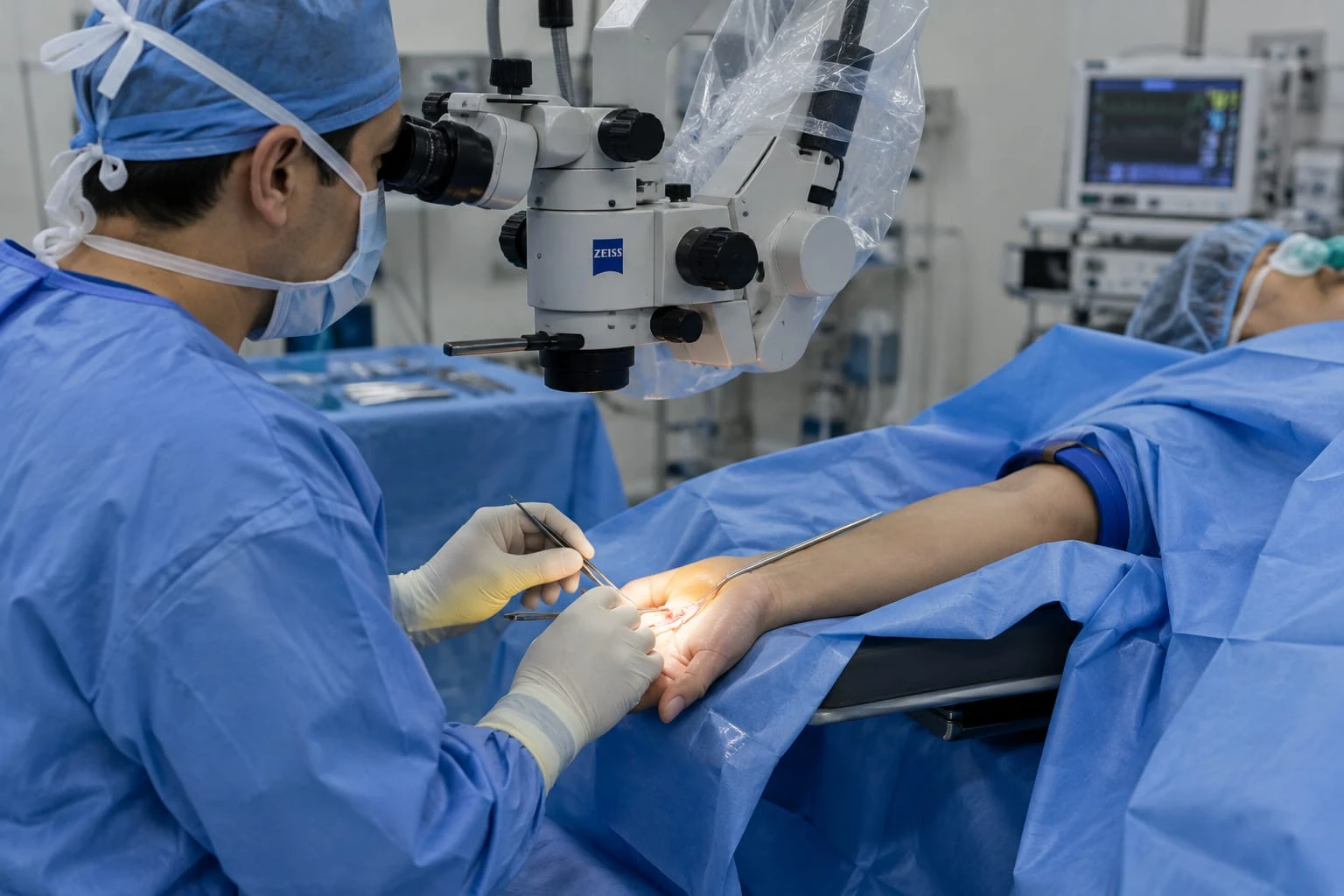
2. Check the operating theatre, not just the consultation room
Most patients evaluate clinics by how the consultation room looks. The room that matters is the one you will not see — the operating theatre. Ask:
- Is the OT certified to JCI or NABH standards?
- Is the anaesthetist a separate consultant (M.D. Anaesthesia), or is the surgeon administering anaesthesia themselves?
- What is the recovery protocol after surgery — private room? Shared ward? Day discharge?
A clinic that performs aesthetic surgery in an in-office procedure room is a red flag for anything beyond minor work under local anaesthesia.
3. Look at before-and-after work for **your specific procedure**
A surgeon may be excellent at rhinoplasty and average at gynecomastia. Ask to see at least six to ten consented patient photographs for the procedure you are considering. Look for:
- Standardised lighting and angles — clinical, not Instagram-filtered.
- Multiple time points — pre-op, three months, six months, twelve months.
- South Asian patients — outcomes on Caucasian patients tell you very little about the surgeon's judgement for your anatomy.
- Transparent honesty — including cases where the result is good but not extraordinary. Surgeons who only show their most flattering work are filtering.
4. Notice how the surgeon discusses risk
This is the single best diagnostic of an ethical practice.
A trustworthy plastic surgeon will, unprompted, tell you the things that could go wrong. They will explain the percentage of patients who need a small revision. They will be specific about scar visibility and recovery time. They will tell you what they will not do — what surgery they would decline, and why.
If your first consultation is exclusively about benefits, walk away. The seller is not your surgeon.
5. Ask who actually performs the surgery
In some hair transplant clinics, the surgeon plans the case and a technician performs the entire procedure. In some aesthetic clinics, a junior trainee performs the operation under the senior surgeon's "supervision" — meaning the senior surgeon is in the building.
Ask directly: "Will you personally perform every step of my surgery?" Get the answer in writing if you can. This is not rude — it is the obvious question.
6. Test the post-operative pathway
Plastic surgery is not finished when you leave the operating theatre. The first six weeks of recovery matter at least as much as the operation itself.
- How are you contacted in those first six weeks?
- Is there a direct phone line or WhatsApp for urgent concerns?
- Who is on the other end of that line at 2 a.m. — the surgeon, a nurse, an answering service?
- How many follow-up visits are scheduled, and at what cost?
A clinic that disappears after payment is a clinic that has prioritised the wrong part of the patient journey.
If you take only one thing from this guide: a plastic surgeon's job is to talk you out of as many operations as they talk you into. Beauty is not a problem that needs fixing. A good surgeon helps you understand whether — and only then how — to act.
The right choice will not feel like a shopping decision. It will feel like a partnership.
Have a question about this article or a procedure? Contact the clinic or book a private consultation.