What Is Reconstructive Microsurgery? Free Flaps Explained
How surgeons rebuild the body after cancer, trauma and chronic wounds by reconnecting blood vessels under a microscope — flap types, recovery and honest risks.
Most people first hear the word "microsurgery" in a difficult moment — after a cancer diagnosis, a serious road accident, or a wound that will not heal. It is rarely a procedure anyone goes looking for. It is the operation that gets discussed when a part of the body has been lost, and the question becomes: can it be rebuilt?
This guide explains what reconstructive microsurgery actually is, in plain terms, without minimising it and without overpromising. It is written for patients and families who have just been told that a free flap may be part of their treatment, and who want to understand what that means before they sit across from a surgeon.
What microsurgery actually means
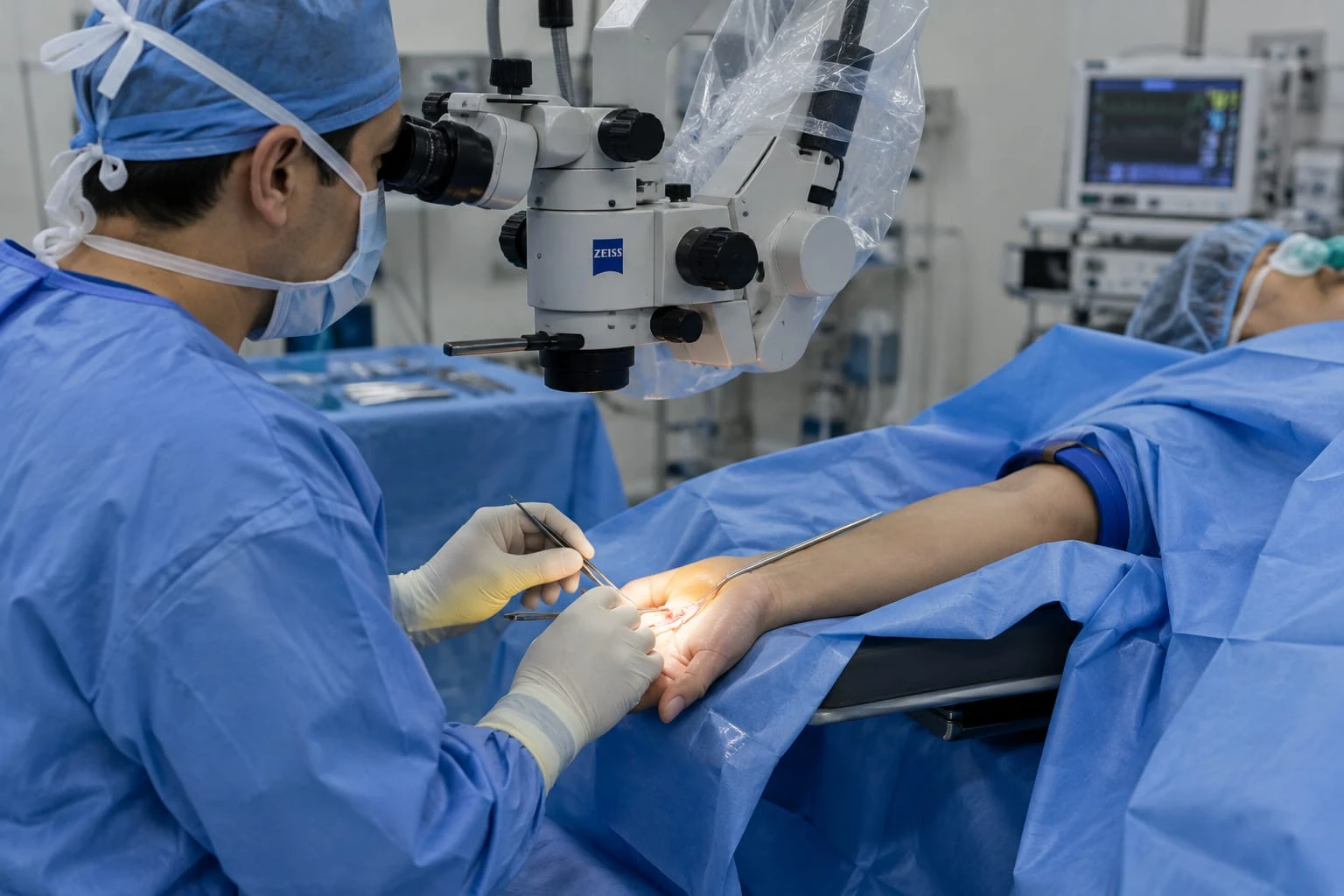
Microsurgery is surgery performed under an operating microscope, working on structures too small to handle reliably with the naked eye. The defining task is reconnecting blood vessels — arteries and veins that are often less than two millimetres wide, narrower than the wire in a paperclip.
To join two such vessels, a surgeon places stitches finer than a human hair, sometimes eight to twelve of them around a single vessel, under magnification of ten to forty times. The thread is so fine it is barely visible without the microscope. A single artery and vein, reconnected correctly, can bring an entire piece of living tissue back to life in its new location.
This is slow, deliberate work. A microsurgical reconstruction often takes six to ten hours, sometimes longer. It is not a procedure that rewards speed. It rewards steadiness, patience, and a great deal of practice.
So what is a free flap?
A "flap" is a block of living tissue — skin, fat, sometimes muscle or bone — that a surgeon moves from one part of the body to another to rebuild a defect.
A free flap is a flap that is completely detached from its original blood supply, carried to a new site, and reconnected to local blood vessels there using microsurgery. The word "free" refers to that complete disconnection. The tissue is, for a few minutes, entirely separated from the body — no blood flowing through it — until the new connections are made and it "pinks up" again.
This is what separates a free flap from simpler techniques. A skin graft is a thin layer of skin with no blood supply of its own; it survives only if the bed beneath it can nourish it. A local flap is rotated from nearby tissue while staying attached to its blood supply. A free flap, by contrast, lets the surgeon take tissue from anywhere on the body and rebuild almost anywhere — a jaw, a breast, a leg, a hand — because it brings its own blood supply with it.
The common flaps and what they rebuild
Surgeons choose a flap based on what needs rebuilding: how much tissue, what kind, and how it must look and function. A few flaps are used often enough that it helps to know them by name.
| Flap | Where it is taken from | What it is used to rebuild |
|---|---|---|
| DIEP | Lower abdomen (skin and fat, sparing muscle) | Breast reconstruction after mastectomy |
| ALT | Outer thigh (skin and fat) | Head and neck, limb, and trunk defects — a versatile "workhorse" |
| Fibula | Lower leg bone (with skin) | Jaw and other bone reconstruction after cancer or trauma |
| Gracilis | Inner thigh muscle | Restoring movement — facial reanimation, limb function |
| Radial forearm | Inner forearm (thin, pliable skin) | Mouth, tongue, and other thin, flexible reconstructions |
The DIEP flap is the one many breast cancer patients will hear about, because it rebuilds a soft, natural breast using the patient's own abdominal tissue while sparing the muscle. The fibula flap can seem startling at first — borrowing bone from the leg to rebuild a jaw — but the leg tolerates the loss well, and the bone takes implants for teeth. The gracilis is remarkable for a different reason: transplanted as living muscle and reconnected to a nerve, it can restore a smile to a paralysed face.
When microsurgery is the right tool
Free flaps are not used lightly. They are reserved for situations where simpler methods cannot do the job. The common ones are:
- Cancer reconstruction — after a tumour is removed from the breast, jaw, tongue, or skin, a large defect is often left behind that must be rebuilt with living tissue.
- Major trauma — high-energy road accidents and industrial injuries can strip away skin, muscle, and bone, exposing tendon or fracture that nothing else will cover.
- Chronic, non-healing wounds — pressure sores, diabetic wounds, and old radiation injuries sometimes need fresh, well-vascularised tissue brought in from elsewhere to finally heal.
- Breast reconstruction — rebuilding the breast after mastectomy, either at the same time as cancer surgery or later.
In each case the principle is the same: bring in healthy tissue with its own blood supply, because the local area can no longer heal on its own.
How the flap is watched after surgery
The first seventy-two hours after a free flap are the most important. The newly connected vessels can clot, and if blood flow stops, the flap is at risk. The earlier a problem is caught, the more likely the flap can be saved — so monitoring is intense and continuous.
In practice, that means a nurse or doctor checks the flap every hour, day and night, in the early period. They look at:
- Colour — a healthy flap is pink; pale can mean the artery is blocked, dusky-blue can mean the vein is.
- Temperature — it should feel warm, like the surrounding skin.
- Capillary refill — press the skin and watch how quickly the colour returns.
- A Doppler signal — a small ultrasound probe listens for the pulse in the flap's vessels.
If the signs change, the team acts quickly. Sometimes a return to the operating theatre within hours can rescue a flap that would otherwise be lost. This is why these operations are done in centres with the staffing and protocols to watch a flap around the clock — the surgery is only half the job; the vigilance afterwards is the other half.
Recovery and rehabilitation
Recovery from a free flap is a longer road than many patients expect, because there are two healing sites — where the tissue was taken (the "donor site") and where it was placed.
A typical hospital stay runs from about five days to two weeks, depending on the reconstruction and the patient's overall health. The early days involve close monitoring, gradual mobilisation, and careful wound care. Swelling is normal and settles over weeks to months. The final appearance of a reconstruction continues to refine for up to a year, and some patients have a small second procedure later to improve contour or symmetry — this is planned, not a sign of failure.
Rehabilitation depends on the flap. After a fibula jaw reconstruction, there is gentle work to regain leg strength. After a gracilis transfer for the face, there is patient retraining as the nerve grows into the muscle — movement can take months to appear. Physiotherapy, good nutrition, and not smoking all make a measurable difference to how well tissue heals.
Success rates, and the honest risks
Free flap surgery is, by reconstructive standards, highly successful. In experienced hands the flap survives in roughly 95 to 98 percent of cases, meaning total flap failure occurs in about two to five percent. Those are reassuring numbers for an operation this demanding.
But it would be dishonest to leave it there. The real risks include:
- Flap failure — if the blood supply cannot be restored, the flap is lost, and another reconstruction may be needed.
- Partial flap loss — a portion of the tissue does not survive and needs further care.
- Clots needing a second operation — caught early, these are often reversible.
- Donor-site problems — wound healing issues, weakness, or scarring where the tissue was taken.
- The ordinary risks of long surgery — infection, bleeding, and the strain of many hours under anaesthesia.
A surgeon worth trusting will walk you through these unprompted, and will tell you honestly whether you are a good candidate — your general health, diabetes control, and smoking history all change the odds. If the conversation is only about the good outcome, that is a warning sign.
Why the surgeon's experience matters here
In few operations does experience matter as plainly as in microsurgery. The difference between a vessel anastomosis that stays open and one that clots can come down to technique honed over hundreds of cases. Equally important is judgement — choosing the right flap, recognising trouble in a flap at 3 a.m., and knowing when to re-operate without hesitation.
In India, and in Ahmedabad specifically, microsurgical reconstruction is performed at a high standard, and the country has a deep tradition in this field. What matters is finding a unit that does this work regularly — that has the microscope, the trained nursing staff for round-the-clock flap monitoring, and a surgeon who performs free flaps as a routine part of practice rather than occasionally. Volume and infrastructure, together, are what make these numbers hold.
If you or someone you love is facing a reconstruction, the most useful thing you can do is ask questions until you understand the plan: which flap, taken from where, what the recovery looks like, and what happens if something goes wrong. A good reconstructive surgeon will welcome those questions, because the patients who understand their own treatment tend to heal better and worry less.
Reconstruction cannot undo what was lost. But done well, it can give back form, function, and a great deal of normal life — and that is quietly remarkable work.
Have a question about this article or a procedure? Contact the clinic or book a private consultation.